

Large purchases often require financial support, and many buyers look for options beyond traditional banks. In-house financing offers a direct path where the seller provides credit to the customer. You deal with one party, from purchase to repayment, which creates speed and convenience. Retailers, car dealerships, and even medical providers use this method to close sales and make products more accessible.
The appeal lies in flexible approval standards and faster processing. According to Experian, nearly one-third of borrowers with subprime credit secured loans through dealer or retailer financing in 2023. That shows how in-house financing opens doors for buyers who might face rejection elsewhere. At the same time, higher interest rates and limited protections raise important questions about long-term costs.
What Is In-House Financing?
In-house financing means a company or retailer gives credit directly to you instead of sending you to a bank or credit union. You borrow from the seller and repay the seller. Large purchases such as cars, homes, medical procedures, appliances, and electronics often use this method.
Cutting out third parties creates a faster and simpler process. You gain access even if your credit history is weak. A 2023 survey by Experian showed that 34% of borrowers with subprime credit secured loans through dealer or retailer financing.
How Does In-House Financing Work?
The process takes place at the point of sale.
- Application – You apply directly with the retailer.
- Credit Review – The finance team checks your income, employment, and credit record.
- Approval and Terms – If approved, you receive a contract with loan amount, interest rate, and repayment schedule.
- Repayment – You pay the retailer or its finance arm each month.
Approvals often happen the same day. A report by TransUnion in 2022 noted that over 60% of point-of-sale loans were approved within 24 hours.
What Are the Pros and Cons of In-House Financing?
| Advantages | Drawbacks |
| Easier approval for weak or limited credit | Higher interest rates than banks |
| Faster process with same-day approval | Limited product options |
| Flexible terms such as low down payments | Fewer consumer protections |
| One-stop convenience at the retailer | Higher total cost over time |
Which Industries Use In-House Financing?
- Automotive – Car dealerships approve buyers that banks reject. Ford Credit and GM Financial handle millions of loans each year. In 2021, over 80% of U.S. car buyers used dealer-arranged financing.
- Real Estate – Developers in emerging markets provide direct financing to attract buyers.
- Medical and Dental – Clinics offer payment plans for cosmetic surgery and dental implants.
- Retail and E-commerce – Stores like Apple, Home Depot, and Ashley Furniture issue in-store credit cards or installment loans.
- Fintech and POS Credit – Platforms such as Affirm and Klarna provide instant approvals. A McKinsey report estimated that 15% of U.S. retail transactions will use POS credit by 2025.
How Does In-House Car Financing Compare to Bank Loans?
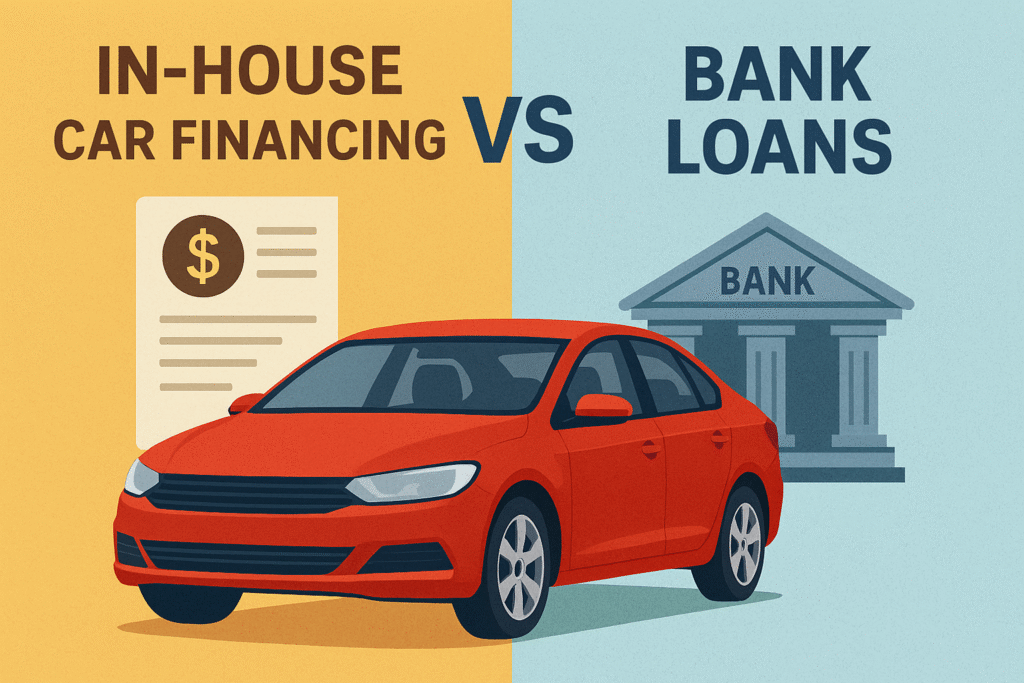
Car buyers face two main options.
- Bank Loans – Lower interest rates, stronger protections, but stricter approval.
- Dealer Loans – Faster approval, flexible promotions, but higher long-term costs.
A J.D. Power study in 2022 found that 42% of buyers chose dealer financing for convenience, even when bank rates were lower.
When Should You Choose In-House Financing?
Best choice if:
- You have poor credit and need approval.
- You want a fast and simple process.
- You plan to buy a specific product from that retailer.
Less ideal if:
- You qualify for lower rates at banks.
- You want to compare multiple lenders.
- You want to minimize long-term costs.
What Is the Final Takeaway?
In-house financing gives you speed, access, and convenience. It helps you buy when banks turn you away. Yet higher costs and weaker protections demand caution.
Fintech growth is reshaping the market. Instant approvals and flexible terms are now common. The smart move is to compare offers, calculate total costs, and read every clause before signing.
FAQs
1. What does in-house financing mean?
In-house financing means the seller provides credit directly to you instead of sending you to a bank or third-party lender. You borrow from the company and repay the company.
2. Is in-house financing easier to get approved for?
Yes. Approval is often easier because retailers set their own requirements. Many approve buyers with weak or limited credit.
3. Do in-house loans have higher interest rates?
Yes. Interest rates are usually higher than bank loans because the retailer takes on more risk. Over time, this can increase the total cost of your purchase.
4. What industries use in-house financing?
Car dealerships, real estate developers, medical and dental providers, and large retailers all use in-house financing. Fintech companies also offer point-of-sale credit platforms that speed up approvals.
5. How fast is the approval process?
Approvals often happen the same day. Some fintech-powered platforms provide instant credit decisions at checkout.
6. Is in-house financing better than a bank loan?
It depends on your situation. Bank loans usually offer lower rates and stronger protections. In-house loans provide faster approval and easier access if your credit is weak.
7. Can in-house financing improve my credit score?
Yes. If the retailer reports your payments to credit bureaus, consistent on-time payments can improve your credit score. Always confirm reporting before signing.
8. What risks should I consider?
You face higher interest rates, fewer consumer protections, and limited product choices. Always compare offers and calculate the total cost before agreeing.
9. Who benefits most from in-house financing?
Buyers with poor credit, buyers who need fast approval, and buyers committed to a specific product benefit most.
10. What should I check before choosing in-house financing?
Check the interest rate, repayment schedule, fees, and whether the retailer reports payments to credit bureaus. Read the contract carefully to avoid hidden costs.
“QuickFast — Your fast lane to expert ideas & deeper stories.”


