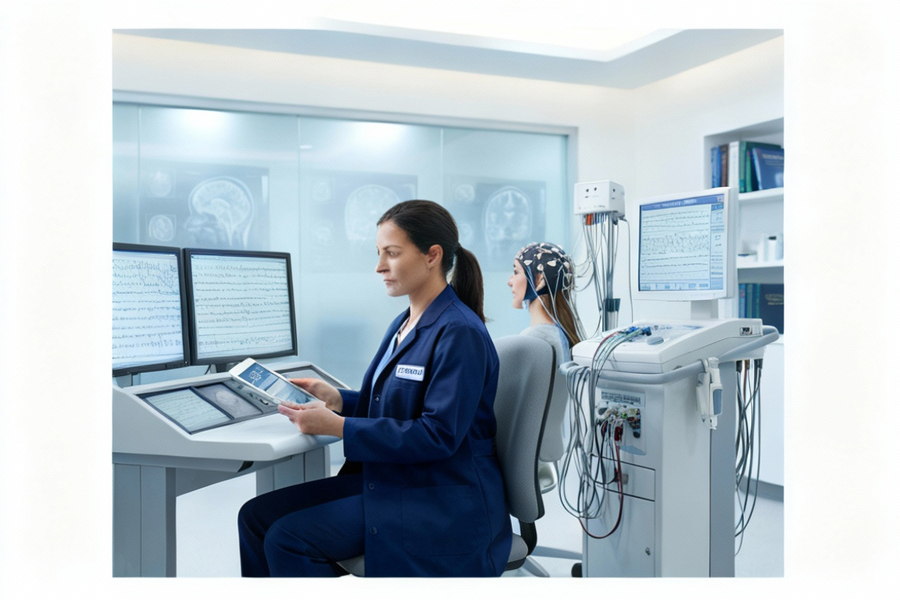

An EEG tech (Electroencephalogram Technician) is a healthcare professional who records and monitors brain activity to diagnose neurological conditions such as epilepsy, sleep disorders, strokes, and brain injuries. You work closely with neurologists, ensuring accurate test results and supporting treatment decisions.
Demand for neurodiagnostic services is rising worldwide. Hospitals, clinics, and specialized centers increasingly rely on EEG technicians. Strong career prospects, competitive salaries, and specialization opportunities make EEG technology a rewarding career path for those interested in healthcare and medical technology.
What Does an EEG Tech Do?
- Conduct EEG tests: Place electrodes on the scalp, monitor patient responses, and record brain activity.
- Interpret results: Identify abnormalities and report findings to neurologists.
- Perform specialized procedures: Routine EEGs, sleep EEGs, ambulatory EEGs, video EEGs, and intraoperative monitoring.
- Provide patient care: Explain procedures, reassure patients, and ensure safety during testing.
How Do You Become an EEG Tech?
- High school preparation: Focus on math, biology, physics, and communication.
- Certificate programs: 12–18 months, covering EEG techniques and patient care.
- Associate degree: 2 years, including clinical rotations.
- Bachelor’s degree: 4 years, offering advanced neurodiagnostic training.
Example: Concorde Career College offers a CAAHEP-accredited Neurodiagnostic Technology Program completed in 17 months.
What Certification and Licensure Are Required?
- R. EEG T. credential (Registered Electroencephalographic Technologist) from ABRET is the gold standard.
- Requirements: Accredited program or equivalent experience, 50 EEG procedures, CPR/BLS certification.
- Exam: Computer-based, $700 fee, 4 hours, multiple-choice.
- Renewal: Every 5 years with continuing education credits.
What Skills Do EEG Techs Need?
- Technical expertise with EEG equipment
- Attention to detail and analytical skills
- Compassion and empathy for patients
- Communication and interpersonal skills
- Problem-solving and troubleshooting abilities
- Time management and computer literacy
What Is the Salary and Career Outlook?
According to 2026 data:
- Average salary: $55,000–$85,000 annually
- Hourly rate: $25.67, ranging $19–$34
- Entry-level: $45,000–$60,000
- Mid-level (3–5 years): $60,000–$75,000
- Senior-level (6+ years): $75,000–$95,000
- Supervisory roles: $90,000–$110,000+
Career growth includes specialization in sleep studies, evoked potentials, intraoperative monitoring, or leadership roles such as lead technologist or clinical supervisor.
What Are People Searching About EEG Tech in 2026?
Latest queries include:
- “EEG tech salary 2026”
- “How long does it take to become an EEG tech?”
- “EEG tech certification requirements”
- “Is EEG tech a good career?”
- “EEG tech vs sleep technologist”
- “EEG tech hourly pay”
- “EEG tech specialization options”
Search interest peaks around career planning seasons (spring and fall) and during healthcare job fairs.
FAQs
1. How long does it take to become an EEG tech?
1–2 years for certificate/associate programs; 4 years for a bachelor’s degree.
2. Do I need a license?
Licensing varies by state or country; certification is widely required.
3. What certification is needed?
The R. EEG T. credential from ABRET is the gold standard.
4. Where do EEG techs work?
Hospitals, clinics, epilepsy centers, sleep labs, and surgical monitoring units.
5. Is EEG tech a good career?
Yes. It offers strong demand, competitive pay, and specialization opportunities.
6. Can EEG techs specialize?
Yes, in areas like intraoperative monitoring, sleep studies, or neurodiagnostic technology.
Conclusion
An EEG tech career blends healthcare, technology, and patient care. With growing demand for neurodiagnostic services, EEG technicians enjoy strong job security, competitive salaries, and advancement opportunities. From certificate programs to advanced degrees, the path to becoming an EEG tech is accessible and rewarding, making it an excellent choice for those passionate about neurology and medical technology.
Speedy coverage. Thoughtful perspective. Only on QuickFast