
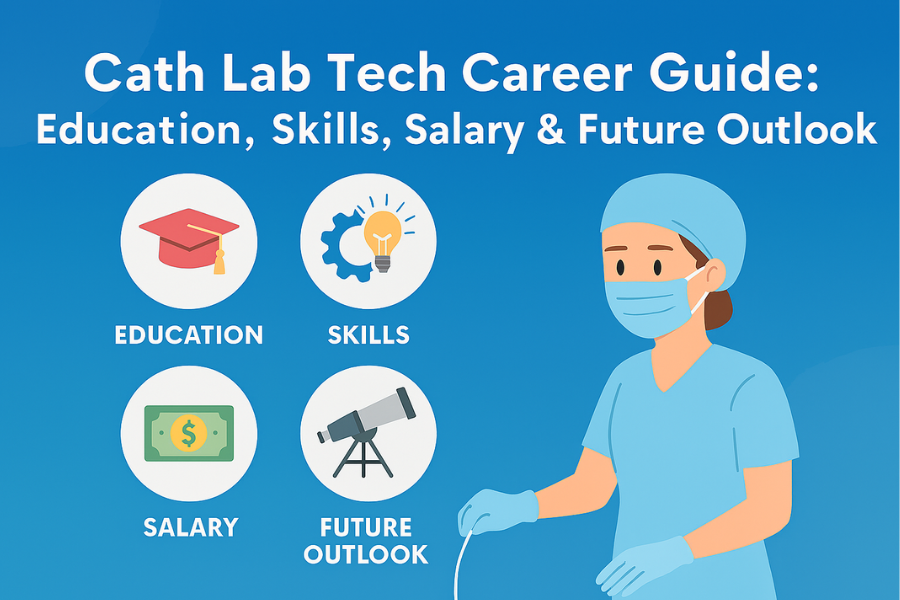

Heart disease remains the leading cause of death worldwide, and the demand for skilled professionals in cardiovascular care continues to rise. Among the most vital members of the cardiac team is the Cath Lab Tech, a specialist who supports cardiologists during life-saving procedures.
You step into a role that blends advanced medical technology with direct patient care. From preparing patients for catheterization to assisting in angioplasty or pacemaker placement, your work directly impacts survival and recovery. Hospitals, outpatient clinics, and specialized cardiac centers rely on Cath Lab Techs to keep procedures safe, efficient, and precise.
The path to this career requires education, certification, and a unique skill set. Salaries remain competitive, and job growth outpaces the national average due to an aging population and advances in minimally invasive treatments.
Do you want a career where every procedure can change a life? This guide explains everything you need to know about becoming a Cath Lab Tech—education, skills, salary, and future opportunities.
What Is a Cath Lab Tech?
A Cath Lab Tech, also called a Cardiac Catheterization Technologist, works beside cardiologists in a cardiac catheterization laboratory. The role focuses on diagnosing and treating cardiovascular disease through minimally invasive procedures such as angiograms, angioplasty, stent placement, and pacemaker insertion.
You combine technical skill, patient care, and emergency readiness in this career. Do you want a role where precision and compassion meet in life-saving work?
What Does a Cath Lab Tech Do?
Cath Lab Techs handle a wide range of responsibilities:
- Patient Preparation and Education
- Collect medical histories.
- Explain procedures to reduce anxiety.
- Prepare patients for interventions.
- Assisting During Procedures
- Support cardiologists during catheter insertions, angioplasty, and stent placement.
- Administer contrast media and medications under supervision.
- Maintain sterile conditions.
- Monitoring and Emergency Response
- Track vital signs and cardiac rhythms.
- Recognize arrhythmias.
- Respond to emergencies.
- Equipment Operation and Maintenance
- Operate fluoroscopy, EKG, and hemodynamic monitoring systems.
- Troubleshoot and maintain cath lab equipment.
- Documentation and Data Management
- Record procedural data.
- Maintain accurate patient files.
How Do Cath Lab Techs Compare to Related Roles?
| Role | Specialty | Key Responsibilities |
| Cath Lab Tech | Cardiovascular system | Catheterization, angioplasty, stents, pacemakers, arrhythmia recognition |
| Interventional Radiology Tech | Imaging-guided procedures | CT/MRI/ultrasound imaging, tumor ablation, vascular interventions |
| Electrophysiology (EP) Tech | Heart rhythm disorders | Pacemaker/defibrillator implantation, arrhythmia monitoring, ablation support |
Do you see yourself more in cardiovascular care, imaging, or heart rhythm management?
How Do You Become a Cath Lab Tech?
Education
Most candidates complete a two-year associate degree in Cardiovascular Technology, Radiologic Technology, or a related field. Coursework covers:
- Anatomy and Physiology
- Medical Terminology
- Radiologic Imaging and Safety
- Patient Care and Communication
Clinical rotations in hospitals or cath labs provide hands-on training.
Certification and Licensing
Certification improves employability:
- RCIS (Registered Cardiovascular Invasive Specialist) – Cardiovascular Credentialing International (CCI).
- ARRT Cardiac Interventional Radiography Certification – American Registry of Radiologic Technologists.
- BLS and ACLS – Basic and Advanced Cardiac Life Support.
Additional Requirements
- CPR certification.
- Updated immunization and health records.
- Background checks and drug screenings.
What Skills Do You Need?
- Technical proficiency in imaging and monitoring systems.
- Attention to detail in high-stakes procedures.
- Critical thinking during emergencies.
- Clear communication with patients and teams.
- Stress management in fast-paced environments.
Would you thrive in a role where every second counts?
Where Do Cath Lab Techs Work?
Cath Lab Techs work in:
- Hospitals, including specialized cardiovascular centers.
- Outpatient clinics offering minimally invasive procedures.
- Dedicated cardiac care centers.
Schedules often include on-call shifts for emergencies. Are you ready for a career that demands flexibility?
How Much Do Cath Lab Techs Earn?
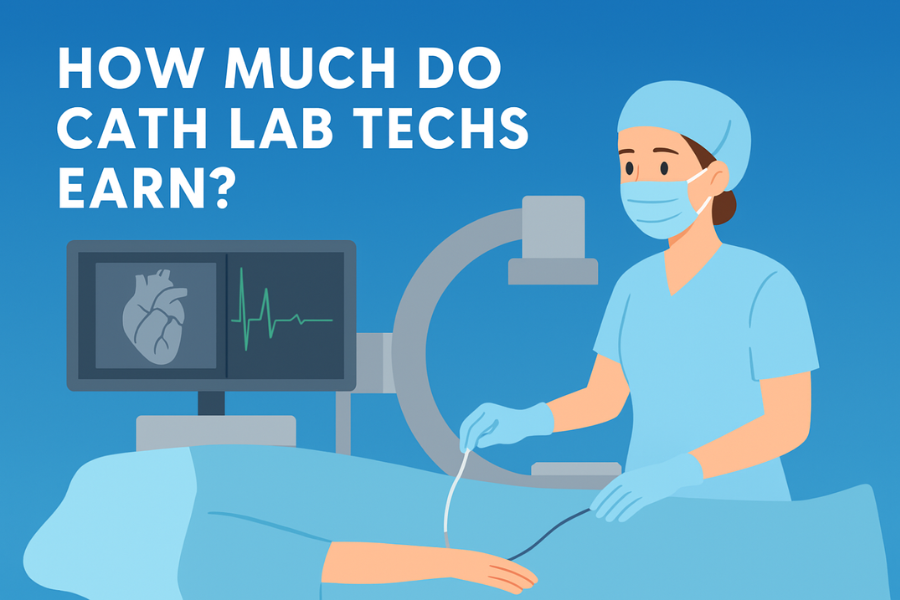
According to Salary.com, the average annual salary for Cath Lab Techs in the U.S. is $84,341, ranging from $61,968 to $99,521 depending on experience and location [2].
ZipRecruiter reports that Washington, D.C., and New York rank among the highest-paying regions, with Washington offering salaries 13% above the national average [1].
AMN Healthcare lists Delaware, Oregon, Virginia, and Texas among the top-paying states for travel Cath Lab Techs [3].
Would relocation to a high-demand state accelerate your career growth?
What Is the Career Outlook?
The Bureau of Labor Statistics projects faster-than-average growth for cardiovascular technologists due to:
- An aging population.
- Rising cardiovascular disease rates.
- Advances in minimally invasive procedures.
Specialization in Electrophysiology or Interventional Radiology can further expand opportunities.
How Can You Advance Your Career?
- Earn advanced certifications such as RCIS or ARRT.
- Move into leadership, education, or management roles.
- Pursue a bachelor’s or master’s degree in healthcare.
Is the Job Hard?
The role demands long hours, high pressure, and emergency readiness. Yet the chance to directly save lives makes it one of the most rewarding careers in healthcare.
Final Thoughts
A career as a Cath Lab Tech blends technology, patient care, and life-saving interventions. You gain stability, growth, and purpose in a field that continues to expand.
Are you ready to step into a career where every procedure can change a life?
FAQs
1. What does a Cath Lab Tech do?
A Cath Lab Tech assists cardiologists during heart procedures such as angiograms, angioplasty, stent placement, and pacemaker insertion. The role also includes patient preparation, monitoring vital signs, operating imaging equipment, and responding to emergencies.
2. How long does it take to become a Cath Lab Tech?
Most candidates complete a two-year associate degree in Cardiovascular Technology or Radiologic Technology. Clinical rotations in hospitals or cath labs provide hands-on training.
3. Do you need certification to work as a Cath Lab Tech?
Certification is not always mandatory, but it improves career opportunities. The most recognized credential is the RCIS (Registered Cardiovascular Invasive Specialist) from Cardiovascular Credentialing International. The ARRT Cardiac Interventional Radiography Certification is another option.
4. What skills are important for Cath Lab Techs?
Key skills include technical proficiency with imaging equipment, attention to detail, critical thinking in emergencies, strong communication, and stress management in high-pressure environments.
5. Where do Cath Lab Techs work?
Cath Lab Techs work in hospitals, outpatient clinics, and specialized cardiac care centers. Many positions require on-call availability for emergency cases.
6. How much do Cath Lab Techs earn?
According to Salary.com, the average annual salary for Cath Lab Techs in the U.S. is about $84,000, with a range between $62,000 and $99,000 depending on experience and location. High-demand states such as Washington, New York, and Texas often pay above the national average.
7. Is being a Cath Lab Tech a hard job?
The job is demanding and fast-paced. It requires long hours, emergency readiness, and physical stamina. However, the opportunity to save lives makes it highly rewarding.
8. What is the difference between a Cath Lab Tech and a Radiology Tech?
A Cath Lab Tech specializes in cardiovascular procedures, while a Radiology Tech focuses on diagnostic imaging such as X-rays, CT scans, and MRIs. Both roles require technical expertise, but their specialties differ.
9. What is the career outlook for Cath Lab Techs?
The Bureau of Labor Statistics projects faster-than-average growth for cardiovascular technologists. An aging population and rising rates of heart disease drive demand for skilled professionals.
10. How can Cath Lab Techs advance their careers?
Career advancement can include specialization in Electrophysiology (EP) or Interventional Radiology (IR), pursuing advanced certifications, or moving into leadership, education, or management roles.
QuickFast is a content site aiming to attract readers across a range of topics (finance, tech, lifestyle). It may be useful for general overviews, but you should verify critical information from more authoritative sources before relying on it for decisions or detailed guidance.