
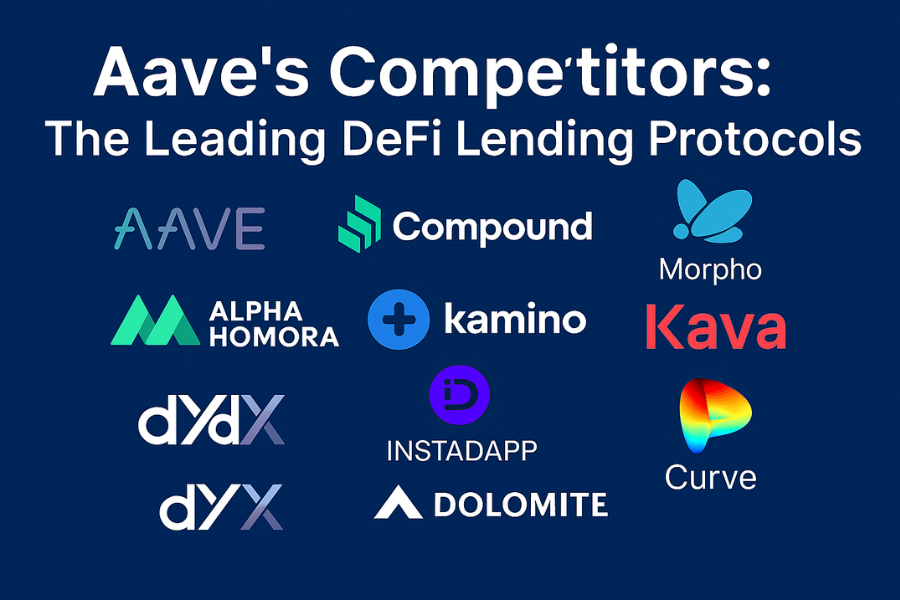

Aave stands as a pioneer in decentralized finance (DeFi). It offers lending, borrowing, and flash loans across multiple blockchains. In 2025, the DeFi lending market has grown more competitive. Compound, MakerDAO, Curve, and new entrants on Solana and Binance Smart Chain are pushing innovation in stablecoins, cross-chain lending, and capital efficiency.
You need to understand how Aave competitors operate if you want to see where DeFi lending is heading.
Why Do Aave Competitors Matter?
- Multi-chain expansion: Protocols now run across Ethereum, Solana, BSC, and Layer-2s.
- Stablecoin battles: Aave’s GHO faces rivals like MakerDAO’s DAI and Curve’s crvUSD.
- Specialization: Competitors focus on niches such as yield farming, derivatives, or cross-chain lending.
- User experience: Faster, cheaper, and simpler platforms attract new users.
DeFi lending volume exceeded $25 billion in total value locked (TVL) across major protocols (DefiLlama). Growth continues in 2025 as multi-chain adoption accelerates.
Who Are the Top Aave Competitors?
1. Compound (COMP)
- Focus: Simple lending on Ethereum.
- Strengths: Proven security, governance-driven upgrades, strong support for ETH, BTC, and USDC.
- Weaknesses: Limited innovation pace, fewer supported assets than Aave.
2. Sky Protocol (formerly MakerDAO)
- Focus: Stablecoin issuance (USDS) and lending via Spark.
- Strengths: Pioneer of decentralized stablecoins, strong governance, expanding multi-chain presence.
- Weaknesses: Complex stability mechanics, fewer collateral options.
3. Curve Finance (crvUSD)
- Focus: Stablecoin liquidity and lending.
- Strengths: Deep liquidity pools, crvUSD adds lending utility.
- Weaknesses: Stablecoin-centric, less versatile than Aave.
4. Kava (KAVA)
- Focus: Cross-chain lending.
- Strengths: Multi-chain interoperability, access to diverse assets.
- Weaknesses: Higher security risks due to cross-chain complexity.
5. Venus Protocol (BSC)
- Focus: Lending on Binance Smart Chain.
- Strengths: Low fees, fast transactions, growing BSC ecosystem.
- Weaknesses: Limited to BSC tokens, shorter track record.
6. dYdX
- Focus: Margin trading and derivatives with lending features.
- Strengths: Advanced tools for traders, governance-driven innovation.
- Weaknesses: Complex for beginners, niche appeal.
7. InstaDApp
- Focus: Aggregator for DeFi lending.
- Strengths: Smart routing for best rates, simplified multi-platform access.
- Weaknesses: Dependent on underlying protocols, requires DeFi knowledge.
8. Alpha Homora
- Focus: Leveraged yield farming with lending.
- Strengths: Unique niche, active community.
- Weaknesses: High risk, unsuitable for passive investors.
9. Dolomite
- Focus: Capital efficiency with trading integration.
- Strengths: Combines lending and trading, innovative liquidity use.
- Weaknesses: Smaller ecosystem, early stage.
10. Kamino (Solana)
- Focus: Lending on Solana.
- Strengths: High-speed, low-cost transactions, Solana-native growth.
- Weaknesses: Solana network risks, limited cross-chain reach.
11. Morpho
- Focus: Peer-to-peer lending optimization.
- Strengths: Improves yields for lenders and borrowers, innovative matching layer.
- Weaknesses: Adoption still scaling, competes directly with Aave pools.
How Do Aave Competitors Compare?
| Protocol | Key Focus | Strengths | Weaknesses |
| Aave | Multi-chain lending + GHO | Flash loans, wide asset support | Complex UX |
| Compound | Ethereum lending | Security, governance | Slower innovation |
| Sky Protocol | Stablecoin + lending | USDS, Spark, governance | Complexity |
| Curve Finance | Stablecoin liquidity | Deep pools, crvUSD | Narrow focus |
| Kava | Cross-chain lending | Multi-chain assets | Security risks |
| Venus Protocol | BSC lending | Low fees, fast | Limited to BSC |
| dYdX | Derivatives + lending | Advanced trading tools | Niche appeal |
| InstaDApp | Aggregator | Smart routing, multi-chain | Dependency risk |
| Alpha Homora | Leveraged farming | High-yield niche | High risk |
| Dolomite | Lending + trading | Capital efficiency | Early stage |
| Kamino | Solana lending | Speed, low fees | Solana risk |
| Morpho | P2P lending optimization | Better yields | Adoption stage |
What Trends Shape Aave’s Competition?
- Multi-chain dominance: Kava and Sky Protocol expand across ecosystems.
- Stablecoin battles: GHO, DAI, and crvUSD compete for liquidity.
- Specialization: dYdX and Alpha Homora thrive in niche markets.
- Aggregators: InstaDApp simplifies access to multiple protocols.
📈 According to Messari, stablecoins now account for over 15% of DeFi TVL, showing how central they are to lending competition.
Conclusion
Aave remains a leader in DeFi lending. Its flash loans, wide asset support, and GHO stablecoin give it an edge. Yet competitors are innovating fast. Compound offers reliability, Sky Protocol drives stablecoin adoption, and Kava pushes cross-chain lending.
You need to track Aave competitors closely if you want to understand the future of decentralized lending in 2025.
FAQs
What makes Aave different from its competitors?
Aave offers flash loans, wide asset support, and multi-chain expansion. Competitors often focus on narrower niches such as stablecoins, cross-chain lending, or derivatives.
Who are the main Aave competitors in 2025?
Key competitors include Compound, Sky Protocol (formerly MakerDAO), Curve Finance, Kava, Venus Protocol, dYdX, InstaDApp, Alpha Homora, Dolomite, Kamino, and Morpho.
How does Compound compare to Aave?
Compound focuses on Ethereum-based lending with a strong security record. Aave supports more assets and chains, but Compound appeals to users who prefer simplicity and stability.
Why is Sky Protocol considered a strong rival?
Sky Protocol issues the USDS stablecoin and operates Spark for lending. Its governance model and multi-chain expansion make it a direct competitor to Aave’s GHO stablecoin.
What role do stablecoins play in Aave’s competition?
Stablecoins drive liquidity and adoption. Aave’s GHO competes with MakerDAO’s USDS and Curve’s crvUSD. Control of stablecoin markets often determines lending dominance.
Which Aave competitor focuses on cross-chain lending?
Kava leads in cross-chain lending. It connects multiple blockchains and offers access to both major and emerging assets.
Is Venus Protocol a serious competitor to Aave?
Venus Protocol operates on Binance Smart Chain with low fees and fast transactions. It attracts users in the BSC ecosystem, though its scope is narrower than Aave’s.
How does dYdX differ from Aave?
dYdX specializes in derivatives and margin trading. Aave focuses on lending and borrowing, while dYdX appeals to advanced traders seeking leverage.
What is the advantage of InstaDApp over Aave?
InstaDApp aggregates multiple lending protocols. It routes funds to optimize rates, while Aave operates as a standalone platform.
Which Aave competitor targets yield farming?
Alpha Homora integrates leveraged yield farming with lending. It serves users who accept higher risk for amplified returns.
Are new competitors like Dolomite, Kamino, and Morpho significant?
Yes. Dolomite combines lending with trading, Kamino builds on Solana’s speed, and Morpho optimizes yields through peer-to-peer matching. Each introduces unique innovations that challenge Aave’s dominance.
What trends will shape Aave’s competition in 2025?
Key trends include multi-chain expansion, stablecoin adoption, specialized lending models, and aggregator platforms. These trends will define the next phase of DeFi lending.
Stay ahead. Be inspired. QuickFast insights for life, tech, business & more