
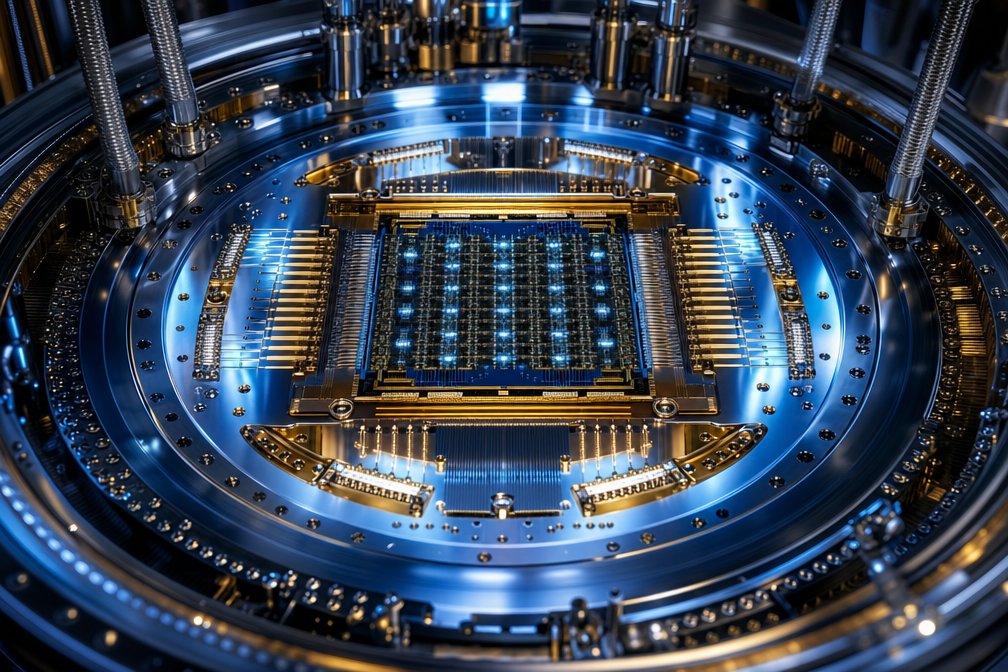

Quantum computing entered a decisive phase in 2024. You saw the shift from raw qubit counts to error correction, logical qubits, and hybrid workflows. Google’s Willow chip proved scaling qubits can suppress errors. Microsoft and Quantinuum advanced logical qubit fidelity. Industry leaders expanded cloud platforms, while governments and investors poured billions into research. The result is clear: quantum computing moved from fragile experiments toward practical systems, opening pathways in chemistry, AI, finance, and energy.
Why does quantum computing matter now?
Quantum computing uses qubits in superposition and entanglement. That allows exploration of many possibilities at once. Current devices belong to the NISQ era with 50–200 qubits. They are experimental but already solving niche problems in chemistry, AI, and physics.
What hardware breakthroughs define 2024–2025?
Google Willow Chip
- 105‑qubit superconducting processor. Achieved below‑threshold error correction. Random circuit sampling finished in minutes vs. classical estimates of billions of years.
Microsoft & Atom Computing
- 24 logical qubits entangled with ytterbium atoms. Gate fidelities above 99.9%.
Quantinuum H2 System
- 56 trapped‑ion qubits. First convincing topological qubit demonstration with Harvard & Caltech. Built‑in resistance to local errors.
Harvard/MIT Real‑Time Error Correction
- 48 logical qubits with live error correction. Awarded Physics World Breakthrough of the Year 2024.
Which algorithms and software advanced fastest?
Quantum Echoes Algorithm
- Molecular structure calculated 13,000× faster than classical supercomputers.
Efficient Shor’s Algorithm
- 10× more efficient than previous versions. Shortens the timeline for breaking RSA and ECC encryption.
Hybrid Quantum‑Classical Workflows
- Microsoft Azure Quantum Elements ran over a million chemistry calculations. Pasqal modeled water molecules inside proteins. Terra Quantum built hybrid neural networks for medical imaging.
How is the industry ecosystem evolving?
- Cloud Platforms: IBM, Google, Microsoft, Amazon, IonQ expanded access.
- Funding Growth: Startups raised billions; governments committed tens of billions.
- Stock Volatility: Firms like Quantum Computing Inc (QUBT) saw sharp swings as commercialization milestones neared.
What challenges remain?
- Scaling: Moving from hundreds to millions of qubits.
- Noise: Qubits lose coherence in microseconds. Cooling and control hardware remain complex.
- Algorithms: Few proven quantum speedups beyond factoring, search, and physics simulations.
- Verification: Hard to check large quantum outputs.
- Security: Shor’s algorithm threatens RSA/ECC. Post‑quantum cryptography adoption is rising.
- Skills & Cost: Rare expertise and expensive infrastructure slow adoption.
Where are real use cases emerging?
- Drug Discovery: Protein binding, solvent modeling, transplant matching.
- Materials & Energy: Battery design, catalysts, fusion plasma modeling.
- Finance & Logistics: Portfolio optimization, routing, scheduling.
- AI & Analytics: Matrix multiplication, eigenvalue estimation, dimensionality reduction.
What comes next (2025–2030)?
- 2025: Early hybrid applications in chemistry and finance.
- 2026: First clear industrial quantum advantage in specialized tasks.
- 2027–2030: Fault‑tolerant machines with tens to hundreds of logical qubits. PQC becomes standard. Quantum accelerators integrated into AI and cloud systems.
FAQs
Is quantum computing real today?
Yes. Devices with 50–200 qubits are available via cloud platforms, but they remain experimental.
Which country leads quantum computing?
The USA, China, and EU are the main powerhouses, with billions invested in national programs.
Can quantum computers break encryption now?
No. Current machines are too small and noisy. The risk is long‑term, hence PQC adoption.
What are the top quantum stocks?
Companies like IBM, Google, Microsoft, IonQ, Quantinuum, and QUBT are closely watched by investors.
Discover trending tech, guides, and smart insights at QuickFast.